

Manual: SWOT analysis
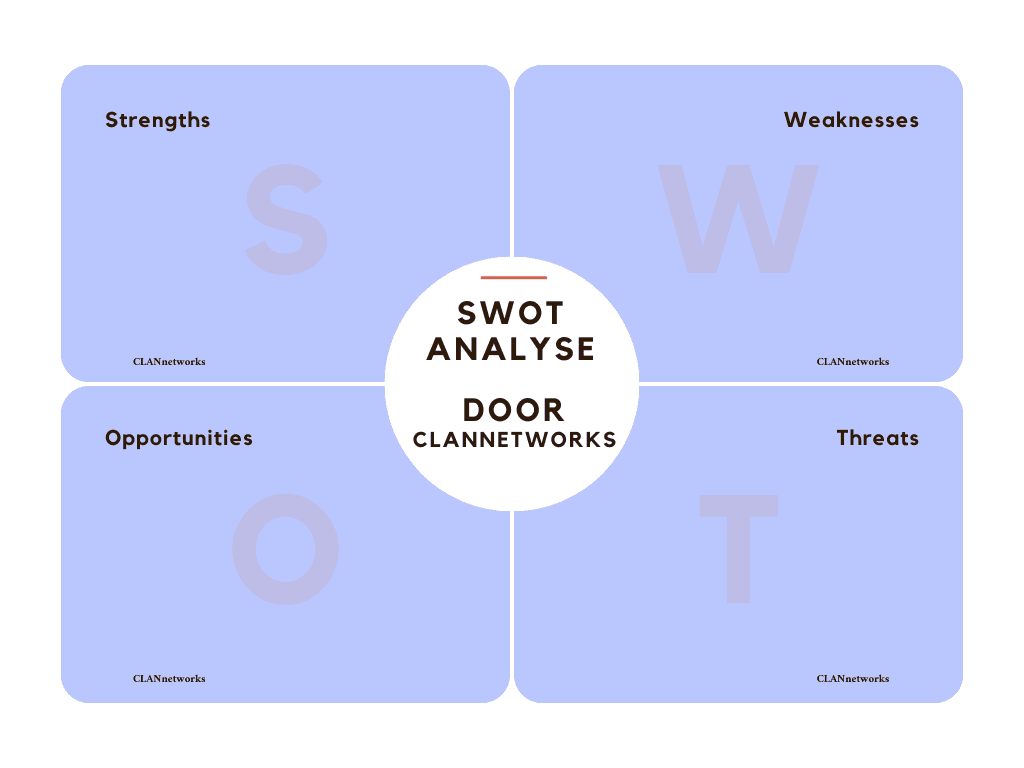
A SWOT (Strengths, Weaknesses, Opportunities, Threats) analysis is a strategic tool that helps companies identify their internal strengths and weaknesses, as well as external opportunities and threats in the marketplace. It is a widely used method to inform business decisions and optimize business strategies. In this guide, I explain the steps of a SWOT analysis and provide examples to clarify each part.
What is a SWOT analysis?
A SWOT analysis is composed of four elements:
- Strengths: The internal characteristics of your company that give you an advantage.
- Weaknesses (Weaknesses): The internal factors that weaken or hinder your business.
- Opportunities: External factors you can take advantage of to grow your business.
- Threats: External factors that pose risks to your business or market position.
SWOT analysis helps you identify strategic options and can be used when making important business decisions, such as entering new markets or developing new products.
Roadmap
Step 1: Strengths.
With strengths, you look at internal factors within your company that provide a competitive advantage. These are the elements that differentiate your company from competitors.
Questions to answer:
- What do we do better than our competitors?
- What unique resources or knowledge do we have?
- Which customers or markets rely on us?
Voorbeeld:
- Coca-Cola has a strong brand and global brand recognition, which provides a huge competitive advantage in the beverage industry. They also have a robust distribution network that allows them to deliver globally.
Step 2: Weaknesses.
Weaknesses are internal factors that somehow disadvantage your business. It is important to identify them honestly so you can improve them.
Questions to answer:
- Where do we lose relative to competitors?
- What resources are we missing?
- Are there complaints or recurring problems from customers?
Voorbeeld:
- Tesla has a strong brand and a sought-after product line, but has historically faced production problems and logistical constraints. This delayed the delivery of their vehicles and made them vulnerable to competitors who have more efficient manufacturing processes.
Step 3: Opportunities.
Opportunities are external factors that you can leverage to grow. They can come from market trends, changing customer needs or new technologies.
Questions to answer:
- What market trends can we exploit?
- Are there emerging customer needs that we can address?
- Are there new technologies or innovations we can use?
Voorbeeld:
- Netflix saw the opportunity to move from renting DVDs to streaming services, which allowed them to capitalize on the emerging demand for on-demand content. They used this opportunity to become the leader in the entertainment industry.
Step 4: Threats.
Threats are external factors that can negatively affect your business. These could be market changes, new competitors or economic shifts.
Questions to answer:
- Which competitors threaten our market share?
- Are there regulatory changes that could hurt our business?
- How do economic trends affect our business?
Voorbeeld:
- Facebook is threatened by increasing regulations around data privacy and user trust, especially after multiple data breach scandals. Stricter data protection laws (such as GDPR in Europe) are having a direct impact on their ad revenue.
How to create a SWOT analysis
- Internal factors (Strengths and Weaknesses):
- Analyze your own company and focus on internal processes, resources and skills. Consider product quality, brand reputation, personnel, technology and internal culture.
- External Factors (Opportunities and Threats):
- Look at the market in which you operate. Focus on the environment: customer behavior, technological advances, economic factors, legal changes and competition.
- Brainstorm and collect data:
- Organize a brainstorming session with your team or analyze customer data and market research to come up with insights. Use both quantitative and qualitative data to get a good idea of your position.
- Complete SWOT matrix:
- Put your insights into the four quadrants (Strengths, Weaknesses, Opportunities and Threats) and look at the connections. Often you can exploit opportunities by using your strengths, or reduce threats by improving your weaknesses.
Sample SWOT analysis of an e-commerce business
| Strengths | Weaknesses |
|---|---|
| – Strong brand and customer loyalty | – Limited product diversity |
| – Well-developed e-commerce site | – Lower brand awareness in new markets |
| – Efficient logistics system | – Less focus on mobile optimization |
| Opportunities | Threats |
|---|---|
| – Growing demand for online shopping | – Increased competition from platforms such as Amazon |
| – Technological innovations in AI | – Changing regulations for online retail |
| – Expansion into new markets | – Economic uncertainty and inflation |
Interpretation: This e-commerce company can use its strong brand and efficient logistics to expand into new markets, but it must also invest in product diversity and mobile optimization to remain competitive with larger players such as Amazon.
Conclusion
A SWOT analysis helps companies develop a strategy by identifying their internal strengths and weaknesses, as well as external opportunities and threats. By systematically analyzing these factors, you can create action plans that ensure growth and success while mitigating any risks.